Ghost ant and white-footed ant infestations in Miami require a precise biological response rather than standard over-the-counter pyrethroid sprays. Both species exhibit polygyne behavior, maintaining multiple…
Ghost ant and white-footed ant infestations in Miami require a precise biological response rather than standard over-the-counter pyrethroid sprays. Both species exhibit polygyne behavior, maintaining multiple reproductive queens across distributed nesting sites. In neighborhoods like Coconut Grove and Coral Way, mature tree canopies and creeping ficus vines provide natural aerial highways directly into attic eaves and window frames. Ghost ants (Tapinoma melanocephalum), measuring roughly 1.3 to 1.5 millimeters, gravitate directly toward indoor moisture sources behind sink vanities and pantry sugar items. White-footed ants (Technomyrmex difficilis) reach approximately 3 millimeters and populate exterior wall voids, palm frond bases, and electrical junction boxes. Applying standard repellent sprays fractures these colonies, triggering a defensive process called budding where secondary queens scatter to establish 4 to 8 new satellite nests throughout the structure.
Eradication depends on slow-acting, non-repellent liquid and gel carbohydrate baits tailored to South Florida’s high humidity. In high-density residential buildings across Brickell, Edgewater, and Wynwood, foraging trails frequently span vertical plumbing chases, moving easily between units. Technician teams map these structural transit corridors without using aerosolized broad-spectrum chemicals that leave volatile organic compound residues or noxious fumes indoors. Foraging worker ants ingest these active ingredients and transfer them back to non-foraging queens and developing larvae through trophallaxis or sterile food-egg distribution. This protocol halts reproduction inside wall voids without requiring disruptive family evacuations.
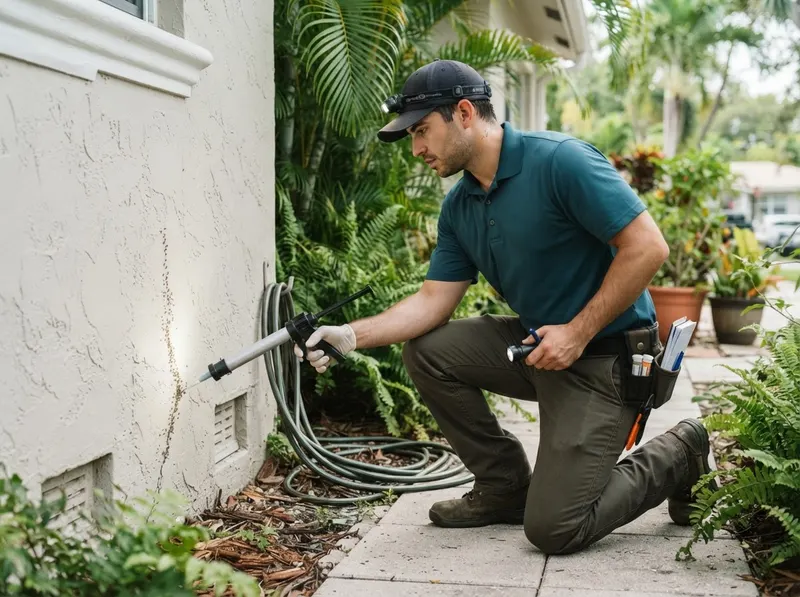
Exterior treatments counter the daily convective summer downpours common near Biscayne Bay, David T. Kennedy Park, and Vizcaya Museum and Gardens. Heavy daily precipitation easily washes away standard surface dusts, which creates false security while exterior populations survive untouched in landscape mulch and decaying wood. Technicians apply water-insoluble, polymer-enhanced microencapsulated barriers around foundation slabs, soffits, and exterior perimeter stems up to 3 feet high. In historic residential pockets such as Little Havana, Silver Bluff, and the Upper Eastside, perimeter protection includes clearing organic ground debris and treating botanical harborage within 10 feet of foundation footings. A 1,200-square-foot condominium treatment requires a different product volume than a 3,500-square-foot multi-story residence, making an in-person assessment essential to map foraging pressure and structural entry points.
Every job gets a firm, written price after a free on-site visit.
Tell us about your ghost ant and white-footed ant control job in Miami and we'll send a clear, written quote, usually the same day.
 Royal Palm Pest Control