Royal Palm Pest ControlRoyal Palm Pest Control

Subterranean Termite Soil Treatment Miami

Subterranean termite soil treatment protects structures from subterranean termite species, including the invasive Asian and Formosan subterranean varieties prevalent throughout Miami-Dade County. Unlike native drywood…
Get My Free Estimate →(645) 465-2596
Subterranean Termite Soil Treatment in Miami, FL
Quick answer
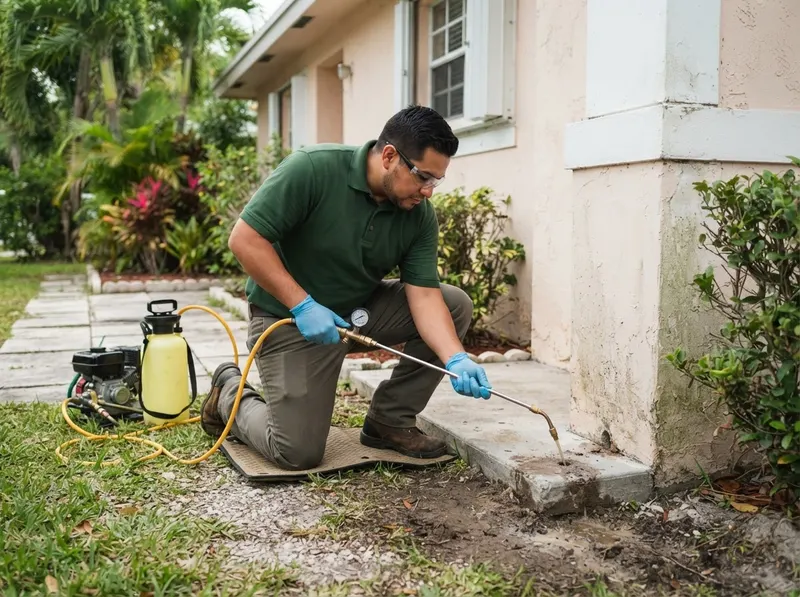
  • Treatment includes foundation trenching, rodding around slabs, and drilling attached exterior concrete pads every 12 inches.
  • Initial property evaluations take 45 to 60 minutes, with complete barrier applications completed in 4 to 8 hours.
  • Ballpark costs range from $950 to $2,800 depending on linear footage, with a strict $250 minimum service charge.
  • The application establishes a subterranean perimeter barrier and does not address drywood termites infesting exposed attic rafters.
  • Arrangements can be made by calling (645) 465-2596 to schedule a foundation inspection and linear measurement.

Subterranean termite soil treatment protects structures from subterranean termite species, including the invasive Asian and Formosan subterranean varieties prevalent throughout Miami-Dade County. Unlike native drywood species that nest inside dry roof timbers and require structural fumigation, subterranean colonies live in moist subsoil and travel into wooden studs through shelter tubes. In areas like Coconut Grove and Silver Bluff, deep limestone shelves and sandy loam soils demand a continuous liquid trench along the exterior stem wall. The standard method requires digging a 6-inch-wide by 6-inch-deep trench directly against the foundation, applying liquid termiticide at a calibrated rate of 4 gallons per 10 linear feet, and backfilling the soil to absorb the material.

Miami properties frequently feature attached concrete features, such as paved driveways in Coral Way, pool decks in Brickell, or covered patios in Little Havana. When concrete directly abuts the foundation, technicians drill 0.5-inch holes spaced 12 inches apart through the slab to rod termiticide into the underlying grade, followed by patching the holes with hydraulic cement. High water tables near Biscayne Bay, David T. Kennedy Park, and The Barnacle Historic State Park require precise application depth to maintain the barrier without product displacement. The non-repellent termiticide binds to soil particles, remaining intact through frequent South Florida tropical downpours without emitting lingering interior airborne fumes.

Property owners must distinguish between subterranean soil defense and drywood spot treatments. If subterranean mud tubes appear along exterior foundation footings or inside hollow concrete blocks, liquid soil treatment provides the necessary perimeter control. However, if wood-colored fecal pellets drop from exposed ceiling joists or window trim, a drywood treatment protocol is required instead. Scheduling requires clear access along the entire external perimeter, moving exterior storage 2 feet away from exterior walls, and securing outdoor water connections before trenching begins.

Subterranean Termite Soil Treatment cost in Miami

Minimum Service / Spot Soil Injection$250, $450
Attached Concrete Slab Drilling (per linear foot)From $250
Full Perimeter Foundation Trench (150, 200 linear ft)$950, $1,650
Large Estate / High Linear Footage Barrier (250+ linear ft)$1,800, $2,800

Every job gets a firm, written price after a free on-site visit.

Common questions

How does heavy rainfall in Miami affect subterranean termite soil treatments?
Modern non-repellent termiticides bind directly to organic matter and sandy soil particles within two hours of application, preventing daily subtropical rainstorms in Miami-Dade County from washing the barrier away.
What is the difference between subterranean soil treatment and drywood termite treatment in Miami?
Subterranean soil treatment saturates the ground perimeter to stop soil-nesting termites, whereas drywood termite treatments target timber-dwelling colonies inside attics or structural framing using direct wood injections or whole-structure fumigation.
Does soil treatment require drilling through concrete patios in Miami properties?
Yes, contiguous concrete slabs, such as patios and walkways in Little Havana or Coral Way homes, require 0.5-inch holes drilled every 12 inches to place termiticide into the sub-slab soil before being sealed with matching cement.
Are chemical odors present inside the home during a subterranean soil application in Miami?
No, because the termiticide is placed outdoors directly into excavated foundation soil and sub-slab ground, the application leaves zero volatile fumes inside living spaces.
How long does a subterranean soil termiticide barrier last in Miami conditions?
Standard foundation barriers provide soil protection for 5 to 10 years, though annual perimeter inspections verify that landscaping disruptions or soil erosion have not compromised the defensive perimeter.

Get started today

Tell us about your subterranean termite soil treatment job in Miami and we'll send a clear, written quote, usually the same day.

Get your free Pest Control Service quote, Miami

We only use your ZIP to check availability, no spam.